

Deepseek R1
Experience the power of DeepSeek R1, an open-source AI model designed for advanced reasoning and problem-solving capabilities.
About Deepseek R1
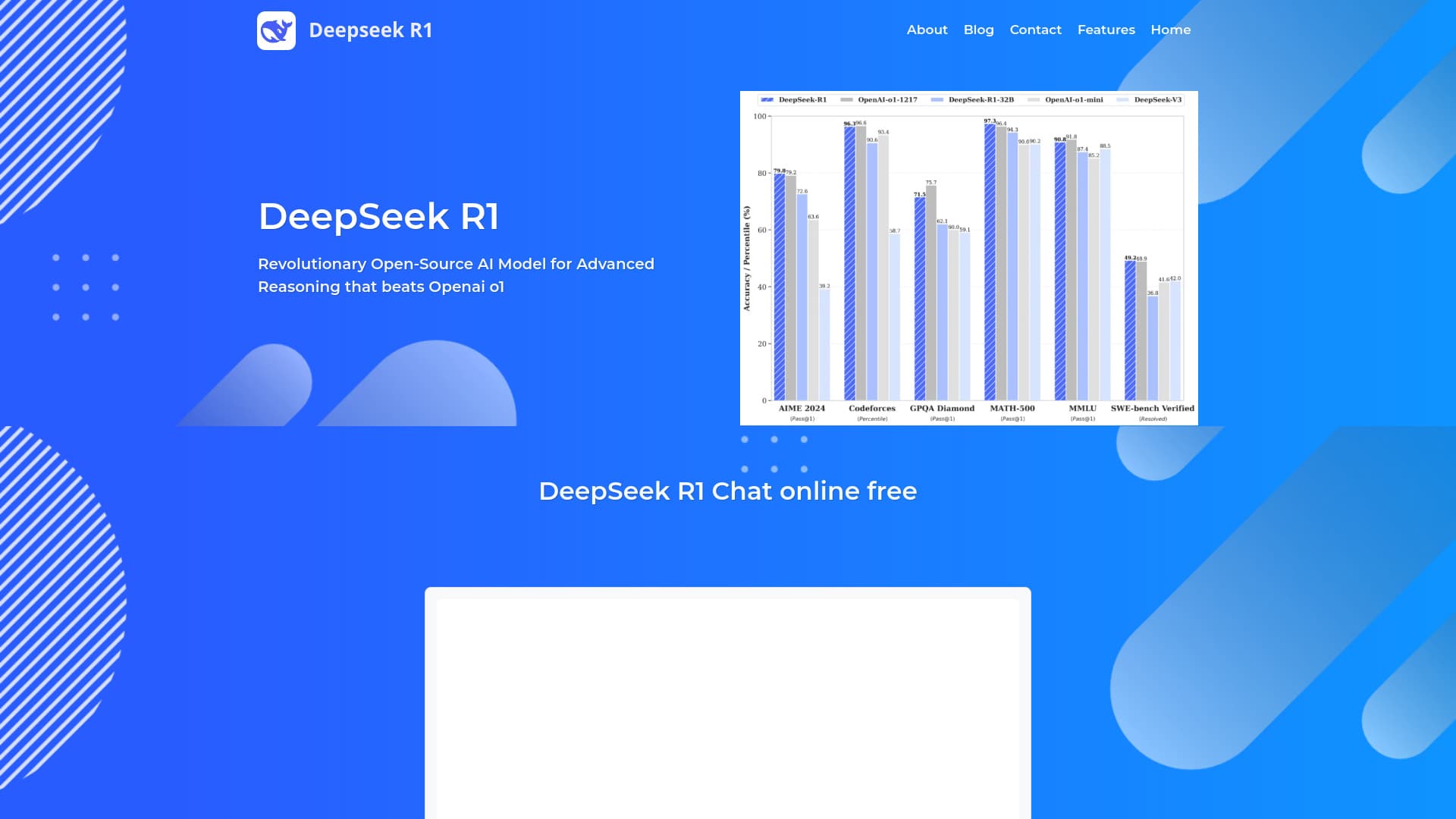
DeepSeek R1 Online offers seamless access to the innovative DeepSeek R1 open-source AI model, renowned for its advanced reasoning and problem-solving skills. The platform provides free, no-login access and supports complex applications such as multilingual understanding, mathematical modeling, and high-quality code generation. Built on a Mixture of Experts (MoE) architecture and reinforced learning techniques, DeepSeek R1 delivers exceptional performance across diverse domains. Users can also explore distilled versions of the model tailored for specific use cases, making it a versatile tool for developers and researchers.
How to Use
Users can interact directly with DeepSeek R1 and V3 models through the online chat interface. The platform also offers DeepSeek R1 WEBGPU Online, enabling local execution within the browser using WebGPU acceleration for fast, in-browser AI testing.
Features
- Visualize reasoning with Chain-of-Thought insights
- In-browser inference accelerated by WebGPU technology
- Access to both DeepSeek R1 and V3 models
- Distilled model variants optimized for commercial deployment
- API endpoint compatible with OpenAI standards
Use Cases
- Enterprise AI code generation
- Advanced AI research projects
- Multilingual natural language processing
- Mathematical and scientific modeling
- Automated code development
- Multilingual understanding and translation
- Complex problem-solving in AI
- Mathematical reasoning and analysis
Best For
Pros
- Fully open-source with MIT license
- Supports long contexts up to 128K tokens
- Exceptional performance in reasoning, mathematics, and coding
- Flexible access via online platform or local deployment
- More cost-effective than comparable commercial models
Cons
- Website maintained by the community, not officially affiliated with DeepSeek
- Requires technical knowledge for local setup
- Performance varies depending on model variant and environment