

SpecsPlain
A Chrome extension powered by PaLM AI that simplifies technical specifications (TC39) with clear explanations.
About SpecsPlain
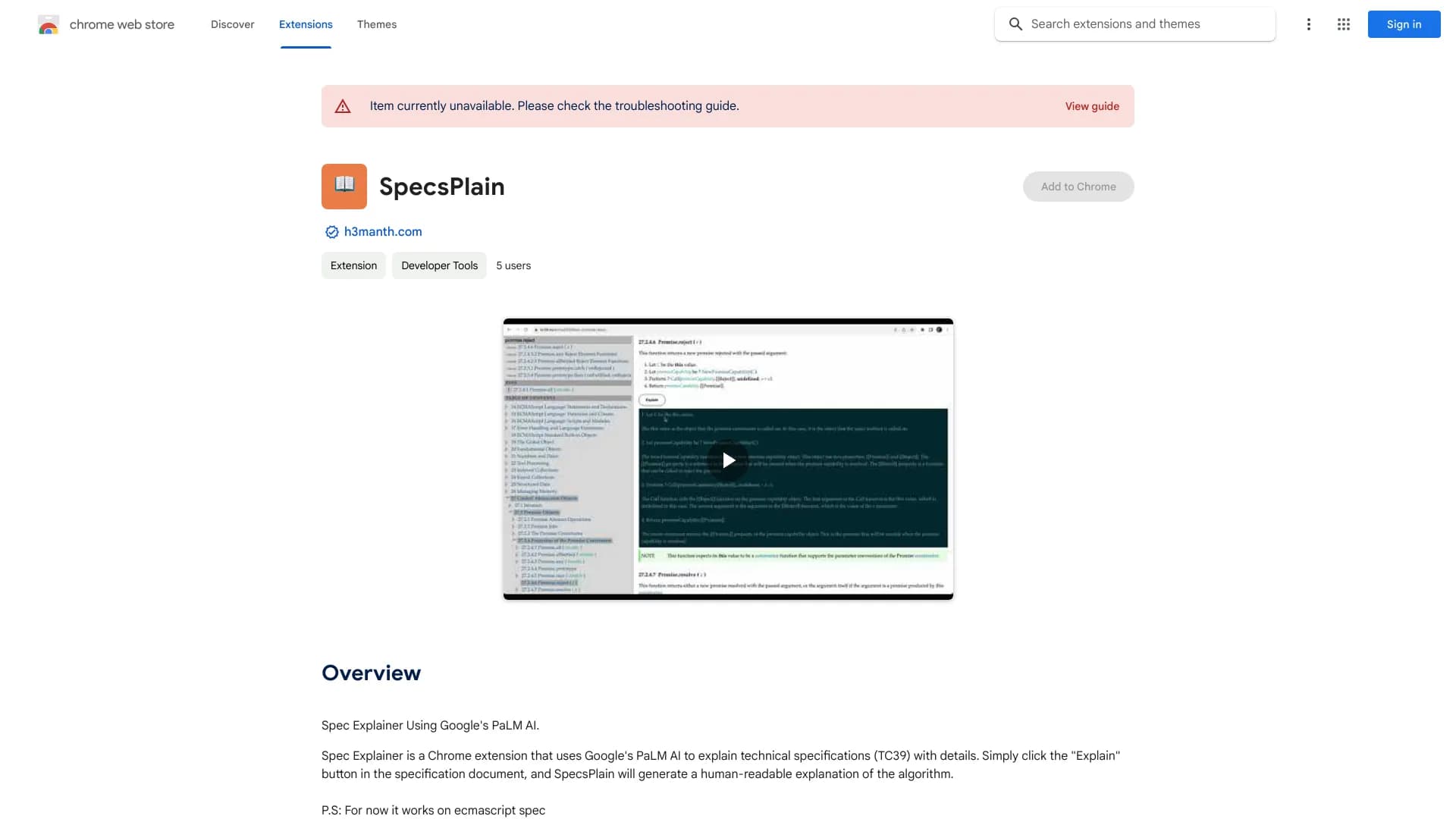
SpecsPlain is a Chrome extension that leverages Google's PaLM AI to clarify technical specifications such as TC39. Simply click the "Explain" button within a spec document, and SpecsPlain provides an easy-to-understand explanation of the algorithm or feature. Currently, it supports ECMAScript specifications.
How to Use
Install the SpecsPlain Chrome extension. When viewing a specification document, click the "Explain" button. The extension will then generate a clear, human-readable explanation using Google's PaLM AI.
Features
- Provides easy-to-understand explanations of algorithms
- Supports ECMAScript (JavaScript) specifications
- Utilizes Google's PaLM AI for accurate technical explanations
Use Cases
- Simplifying complex technical specifications
- Quickly understanding algorithm functionalities in documentation
Best For
Software developersWeb developersComputer science studentsTechnical writers
Pros
- Makes complex technical details easy to understand
- Simple to use with a single "Explain" button
- Delivers clear, human-readable explanations
Cons
- Quality depends on Google's PaLM AI capabilities
- Currently limited to ECMAScript specifications
- Limited user ratings (0 out of 5)
FAQs
Which specifications are supported by SpecsPlain?
Currently, SpecsPlain works exclusively with ECMAScript specifications.
How does SpecsPlain generate explanations?
When you click the "Explain" button, SpecsPlain uses Google's PaLM AI to produce a clear, human-readable explanation of the selected specification.
Can I use SpecsPlain on other programming languages?
At this time, SpecsPlain only supports ECMAScript (JavaScript) specifications.
Is SpecsPlain free to use?
Yes, SpecsPlain is available at no cost for users seeking to understand technical specifications.
How accurate are the explanations provided?
Explanations are generated by Google's PaLM AI, which offers high-quality insights, but accuracy may vary depending on the complexity of the specification.