

SyntheticAIdata
Synthetic data generation platform designed to enhance training of vision AI models while prioritizing privacy and regulatory compliance.
About SyntheticAIdata
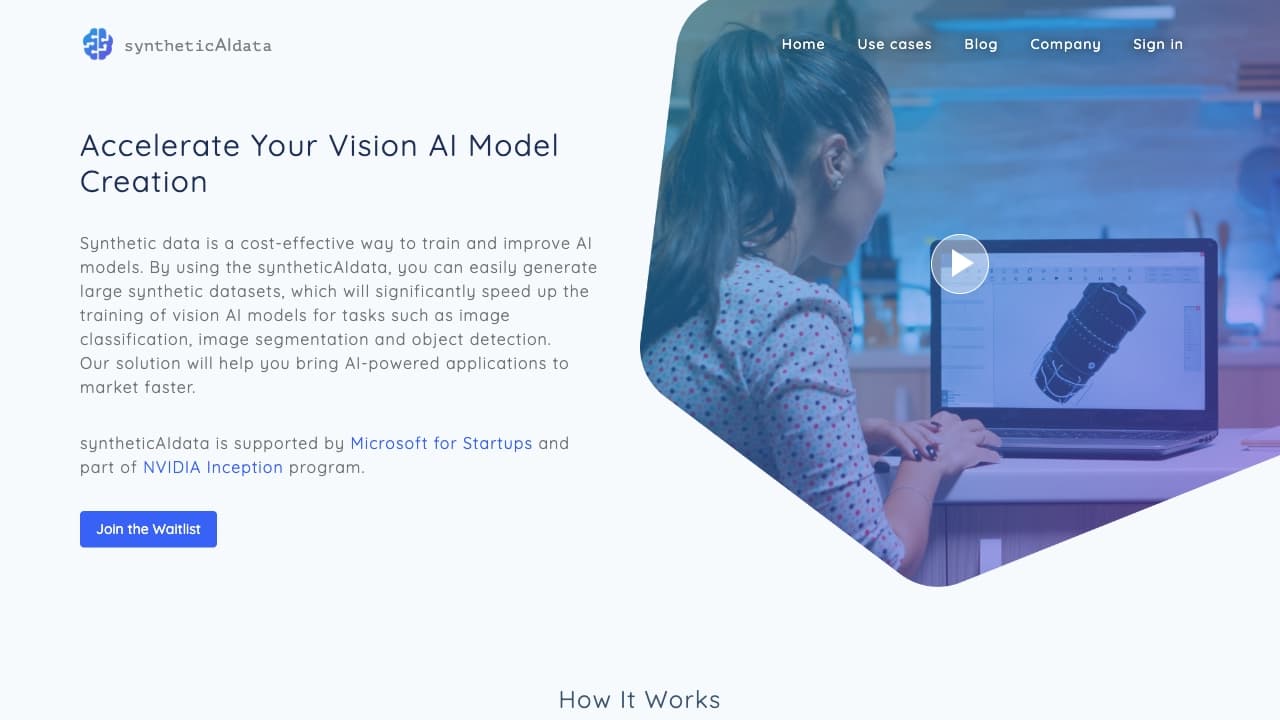
syntheticAIdata enables businesses to generate large volumes of high-quality synthetic data essential for training computer vision AI models. It simplifies dataset creation with a user-friendly, no-code interface, ensuring privacy and compliance. The platform supports unlimited data generation, precise annotations, and seamless cloud integrations, accelerating AI development and reducing costs. It helps organizations develop robust vision AI solutions faster, while eliminating privacy concerns associated with real-world data collection.
How to Use
Utilize realistic 3D models to effortlessly create synthetic datasets for object detection and AI classification tasks. No coding skills are required, making data generation accessible to all users. Easily integrate with cloud services through a single click for streamlined workflows.
Features
- High-quality, precisely annotated datasets
- Intuitive no-code data creation
- Seamless cloud platform integrations
- Unlimited synthetic data generation
- Ensures privacy and regulatory compliance
- Cost-effective and scalable data solutions
Use Cases
- Privacy-focused AI development: Creates realistic scenarios without compromising privacy.
- Fast prototyping of AI applications: Accelerates initial testing and development.
- Inclusive AI training: Produces diverse synthetic datasets for fairness.
- Accelerating vision AI deployment: Reduces costs and speeds up time-to-market.
- Faster defect detection: Enhances quality control processes.
Best For
Pros
- User-friendly, no-code platform for easy data creation
- Maintains privacy and regulatory standards
- Cost-effective alternative to real data collection
- Speeds up AI model development cycles
- Supports large-scale data generation for better accuracy
- Simplifies data annotation and management
Cons
- Dependent on the platform for data generation processes
- Synthetic data may not capture all real-world complexities
- Creating realistic environments may require 3D modeling expertise